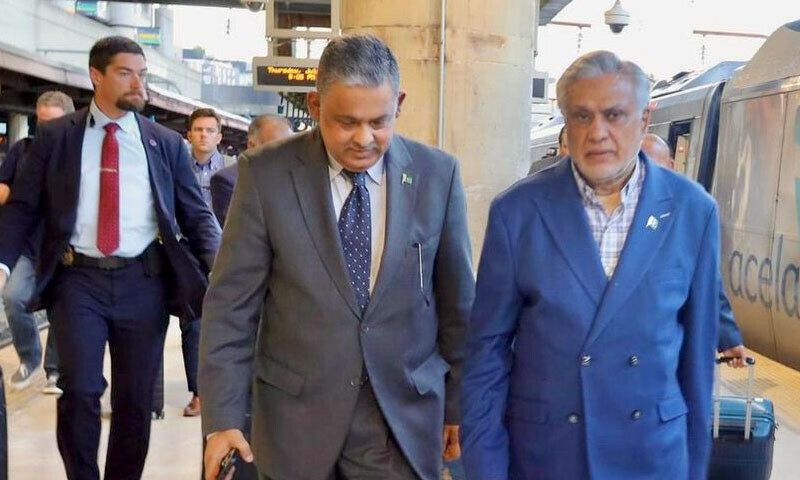
Deputy Prime Minister and Foreign Minister Ishaq Dar arrived in Washington, DC on Thursday night, on the second leg of his eight-day visit to the United States, the Foreign Office said in a post on X.
Dar arrived in New York on Monday to attend ?high-level signature events? of Pakistan?s United Nations Security Council (UNSC) presidency, including a conference on Palestine.
Upon arrival in the US capital, the foreign minister was received by Ambassador of Pakistan to the US, Rizwan Saeed Sheikh and senior embassy officials, the Foreign Office said on X.
Dar is scheduled to meet his counterpart, US Secretary of State Marco Rubio, for a bilateral meeting at the Department of State on Friday, the FO said.
?The meeting will discuss important facets of Pak-US relations, exploring ways and means to strengthen bilateral ties, with a particular focus on promoting trade, investment and economic cooperation,? FO said.
He is also scheduled to speak at the US think tank, The Atlantic Council, ?sharing Pakistan?s perspective on regional and global issues as well as the future of Pak-US relations.?
Dar?s visit comes as Pakistan holds the presidency of the UNSC this month. Pakistan assumed the UNSC presidency for July, marking its first presidency since 2013. Islamabad began its current two-year term as a non-permanent member in January 2025 and will serve through the end of 2026.
Addressing a reception hosted by Pakistan?s Mission in New York on Wednesday, Dar called for an inclusive dialogue and cooperative diplomacy over confrontation amid growing turbulence across the world.
?We believe that global peace and security can only be achieved through multilateralism, peaceful settlement of disputes, inclusive dialogue, and respect for international law.?
The deputy PM pointed out: ?At the core of Pakistan?s foreign policy is our firm commitment to multilateralism and the United Nations.
?The purposes and principles enshrined in the UN Charter, especially the peaceful settlement of disputes and non-use or threat of force, are foundational to the UN. They are indispensable for a just international order,? he added.
The deputy PM asserted that Pakistan?s leadership has been guided by ?these very principles in both deliberations and concrete actions taken during its tenure?.
?This is a time of growing turbulence in the world, where the costs of unresolved disputes, long-running conflicts, unilateral actions, and disregard for international law are being felt in every region of the world,? Dar noted.
The UNSC unanimously adopted Pakistan-sponsored Resolution 2788, calling for the strengthening of international mechanisms to settle disputes through peaceful means.
Dar also announced Pakistan was seeking a seat at the UN Human Rights Council (UNHRC) for the 2026-2028 term, with the Asia-Pacific Group endorsing its candidacy. Pakistan last held the membership from 2020 to 2023.
Dar outlined three priorities that Pakistan will focus on during its UNSC presidency. He described the peaceful settlement of disputes, a core principle of the UN Charter, as ?too often sidelined? and highlighted the need to bring it back to the centre of the council?s work.
?The Security Council must be seen not only as a chamber of reaction but as a forum of prevention, problem-solving, and principled leadership,? he asserted.
He then detailed Pakistan?s third priority ? enhancing cooperation between the UN and regional organisations, particularly the Organisation of Islamic Cooperation (OIC).
Reaffirming Pakistan?s active diplomatic engagement, the deputy PM said the country remained committed to working with partners around the world to advance the shared goals of peace, development, and human rights.
He highlighted Pakistan?s leadership in global climate and development discourse and reiterated its support for strengthening the UN?s three pillars: peace and security, development, and human rights.
Dar urged the global community to rise above divisions. ?In a world facing deepening divides and mounting challenges, we must choose cooperation over confrontation, and diplomacy over force.?
Gaza ceasefire
Chairing the UNSC?s Quarterly Open Debate on the ?Situation in the Middle East including the Palestinian Question?, Dar urged the UNSC and the international community to bring about an immediate and unconditional ceasefire in the Gaza Strip, along with unrestricted humanitarian access amid a food crisis in the besieged territory.
?It is time to give the Palestinian people what they have been denied for too long: justice, freedom, dignity, and a state of their own. That is the path to durable peace and stability in the Middle East,? FM Dar said.
He emphasised that the path to lasting peace lay in upholding international law, ending foreign occupation, rejecting the use of force and advancing solutions through dialogue and diplomacy.
?Gaza has become a graveyard for innocent lives as well as for international law,? Dar said, citing systematic attacks on hospitals, schools, refugee camps and aid convoys.
He emphasised that the unfolding hunger crisis, with a third of Gaza?s population going days without food, was a dire warning of ?catastrophic levels of food insecurity?.
Calling the Palestinian issue a litmus test for the UN?s credibility, FM Dar warned that failure to act decisively would embolden impunity and erode the international rules-based order.
Dar welcomed recent momentum toward Palestine?s recognition and UN membership. He highlighted the upcoming International Conference on the Two-State Solution, co-chaired by Saudi Arabia and France, as a key opportunity for renewed diplomatic progress.
Leave A Comment
Comments
No comments yet. Be the first to comment!


